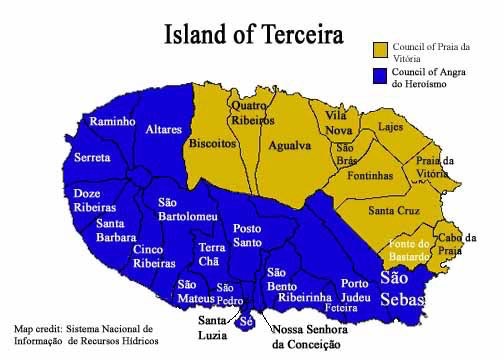
Terceira island, as its name indicates, was the third island of the Azores archipelago to be discovered by Diogo de Silves, in 1449. It was initially called the island of Jesus Christ because it was found on the day when the feast of the Holy Name of Jesus was celebrated or because it belonged to the Master of the Order of Christ. This island began to receive settlers a year after its discovery, having been given to the Captain Donatory Jácome de Bruges. Among these first settlers were some Franciscan friars who arrived here to promote religious worship, since the islands belonged to the Order of Christ.
Already in the 16th century, in the context of the Succession Crisis, in 1580, Terceira island was the headquarters of the Portuguese Kingdom when António Prior do Crato was acclaimed as King, who governed the country from the Azores in order to avoid the supremacy of the Castilians over the Portuguese kingdom. However, after a climate of guerrilla warfare between the Portuguese and the Castilians, in 1640, with the Restoration of Independence, the island of Terceira, as well as the entire archipelago were great supporters of that restoration, which involved some resistance from the Castilians that lasted for two years until the episode of the surrender of the fortress of São João Batista, in Angra.
It was also in this island that the King of Portugal, Afonso VI was imprisoned in the fortresses of the Castle of São João Batista, in Monte Brasil, where he was always greatly greeted and respected by the people of Terceira.
During the Portuguese Civil War (1828-34), the island of Terceira assumed an important position, as it was the stage of the Naval Battle of Praia, in 1829, thus giving the name of Praia da Vitória to this city, due to the victory of the liberals against the absolutists, thus assuring liberalism in Terceira. It was in this island that the Council of Regency was formed in 1832, where D. Pedro IV of Portugal and I of Brazil, made important decisions about the future of the Portuguese Kingdom, highlighting the departure to São Miguel of D. Pedro’s liberal army, which fought in Mindelo.
In the 20th century, during the Second World War, the American air base was built at Lajes – Lajes Air Base – which took great advantage of the geographical location of the Azores. Its purpose was to defend the sovereignty of Portugal and above all to serve as support for the allied forces, namely Great Britain and the United States of America.
Last modified: 2 de November, 2021