


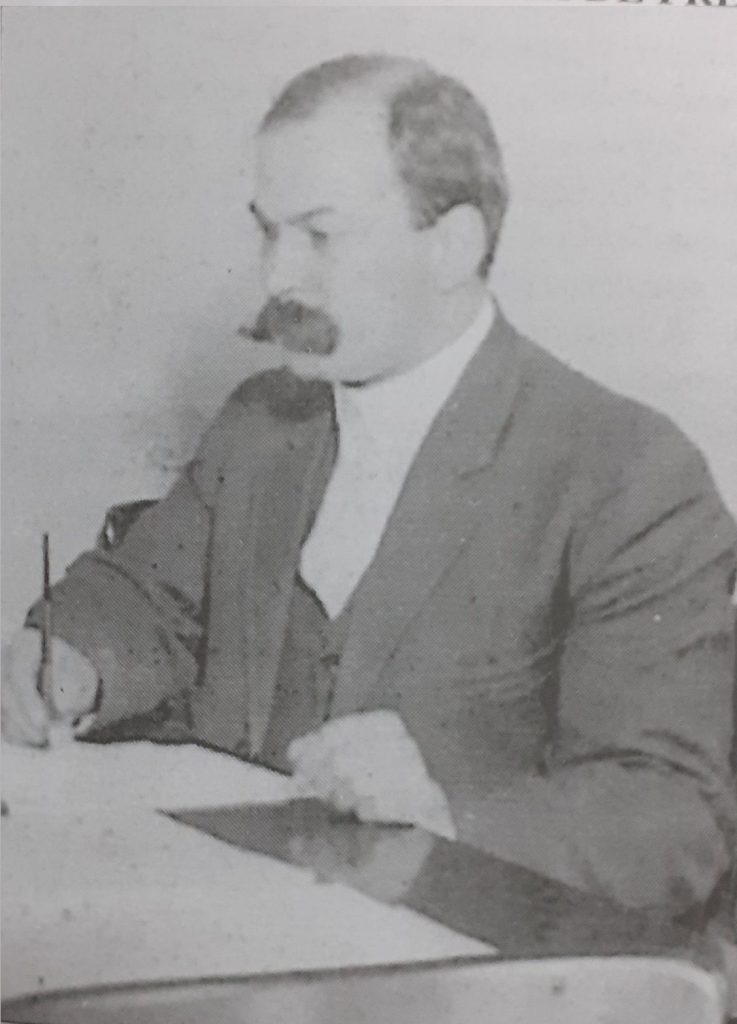


Born on January 19, 1868 in Fazenda, which at the time belonged to the parish and municipality of Lajes das Flores, he was the son of Francisco José Trigueiro and Maria de Jesus Freitas Trigueiro.
Still very young, he emigrated to California in the last years of the 19th century, where he already had several brothers. Gifted with a privileged intelligence and having an excellent primary education done in Lajes das Flores, he soon sought to improve his studies, both in English and Portuguese.
It is said that he even had a banking institution that, due to the instability of the branch occurred in the difficult years of the American economy, after the recession of 1929, would be absorbed by the Portuguese American Bank in San Francisco, where Félix Trigueiro came to work in the role of foreman of the strongbox 1.
In 1898 he came to his homeland on a nostalgic visit, returning directly to the United States aboard the Portuguese ship “Peninsular” which, on October 24, had passed by Flores Island on its regular voyage.
In this regard, the newspaper “The West”, Santa Cruz das Flores, wrote on 29 that month: “That same day left for California our very dear friend Mr. Felix Trigueiro, a native of the farm of Lajes and brother of the distinguished colleague director of the “União Portuguesa” of San Francisco.
“We miss this good friend of ours very much, who has given us proof of great esteem and friendship during his stay on this island, to whom we wish a good trip and the prosperity he is worthy of. 2 It is believed that the person who wrote this news was Father Henrique Augusto Ribeiro, Director of the same newspaper.
He had a great capacity for letters, despite not having attended university, and collaborated with some regularity in the Californian press, both in the Portuguese and English languages. Among the Portuguese community he was considered “the golden feather”, as a Florentine contemporary of his told me.
3 Because of his importance to the Portuguese community and his culture, he was several times Portugal’s Vice-Consul in San Francisco, a position he was replaced by another Florentine, Guilherme Armas do Amaral, from Santa Cruz das Flores.
Especially after the death of his brother Manuel, it was he who, along with his brother’s daughters, promoted the publication of the newspaper “A União Portuguesa”. Besides having collaborated with scattered articles in the American press in California, written in English, he participated in several Portuguese language newspapers, namely the “União Portuguesa” and the “Jornal Português” that were published there.
Félix Trigueiro, in the last years of the 19th century was one of the biggest fundraisers in California for the construction of the church at Fazenda, through Brother Manuel’s newspaper. Later, in the 1930s, he would repeat this help when it went towards the purchase of instruments for the church’s choral group and, above all, for the philharmonic of the same locality.
The funds from this, were so high that those responsible for the creation of this philharmonic – José Gomes Trigueiro, Francisco de Freitas Silva, and Francisco Coelho Gomes – gave it the name of “Colónia Portuguesa da California”, later changed to “União Portuguesa da California”, name of the newspaper where the respective subscriptions were made4. For this reason, the aforementioned philharmonic, which had been formed in 1939, went to greet him in the parish of Fazenda on January 19, 1940, his birthday, in the person of his brother José, as a symbolic gratitude for his commitment in that collection of donations 5.
It was through him that my father, José Gomes Trigueiro, was for several years the correspondent of the newspaper “União Portuguesa”, replacing his brother José de Freitas Trigueiro, after his death. It was also through him that, after that newspaper disappeared on July 13, 1942, my father became, until his death in 1965, the correspondent for the “Jornal Português”, which was also published in California.
At a date we are not able to specify, his death would have occurred in 1944, when his only son Alfredo was in Europe fighting in World War II, as his grandson informed me years ago, in response to an information I asked him about the subject. It is known however that it must have been in April or May, a few days before the war ended.
Years ago, when I saw the letters that Félix Trigueiro wrote to his brother José on the occasion of the creation of the above-mentioned Philharmonic, I could see, without great difficulty, the literary quality with which he expressed himself in them. I also remember my father saying that, although brother Manuel was the Director of the newspaper “A União Portuguesa”, it was Félix who wrote the most brilliant and best structured articles.
It should be noted, incidentally, that the ancestors of the brother, José de Freitas Trigueiro, on the island of Flores and in Vancouver, Canada, despite never having met him, keep excellent sentimental and material memories of him – including photographs, newspapers and letters received from him.
Last modified: 20 de January, 2022


